
This section focuses on understanding neurodiversity at work and using inclusive language, with practical guidance on adjustments you can make to create neurodivergent-friendly team environments.
What Language
Should I Use?
Language shapes our perceptions and attitudes. When talking about neurodivergence, using the right language is essential not only to ensure respect but also to reflect an understanding of the neurological realities that neurodivergent people experience. Language that avoids reinforcing stereotypes or making assumptions about an individual’s abilities is vital for creating inclusive and supportive environments.
The language we use influences how neurodivergent cast and crew feel about themselves and how they are treated. It is crucial to understand that while there are various preferences, neurodivergent people are typically the best source of guidance about the terms that suit them.
Identity-First Language: "Autistic Person" vs "Person with Autism"
In the neurodivergent community, identity-first language is typically preferred. This means saying "autistic person" or "neurodivergent person" rather than "person with autism" or "person with ADHD." This preference reflects the view that neurodivergence is an inherent part of who someone is, not something that can be separated from their identity.
- "Autistic person": This indicates that the individual identifies with being autistic, viewing it as a core aspect of who they are.
- "Person with autism": While still acceptable to some, this term can sometimes imply that autism is a condition that is separable from a person’s identity, which can be dehumanising.
For the most part, it is essential to ask individuals what language they prefer. Some may prefer person-first language for different reasons, and it is important to respect these preferences.
References & Further Reading
- Understanding Neurodiversity Terms - BUPA
- What is Neurodivergence? - Autism UK
- Neurodivergent, Neurodiversity and Neurotypical: A Guide to the Terms - The Brain Charity
Executive
Function
Executive functions act as the brain's management system for daily life. When these skills are not developing at the same pace as expected, day-to-day life can feel chaotic or overwhelming. This is about how the brain processes and prioritises information, often in a non-linear or non-standard way.
Executive functioning difficulties can have a significant impact on life at home, at work and in relationships. It can affect how someone sets goals, completes projects, handles transitions or copes under pressure. In traditional workplaces where time management, organisation and task follow-through are highly valued, this can lead to misunderstandings, burnout or underperformance, not because of lack of effort, but because the support systems are not built with neurodivergence in mind.
These are signs of a brain that works differently and often excels in other areas, such as creativity, problem-solving or big-picture thinking.
Self Awareness: Understanding Your Own Mind
Self-awareness is the foundation of executive functioning. It is the ability to reflect on your thoughts, emotions and behaviours in real time. For many neurodivergent individuals - especially those who are late diagnosed - developing self-awareness can be delayed or distorted by years of masking or trying to fit neurotypical expectations. Building this skill is key to making empowered, authentic choices and recognising when support is needed.
Problem-Solving: Stuck Spinning or Overthinking?
Problem-solving involves analysing a challenge, generating solutions and deciding on a course of action. For neurodivergent people, this process can be deeply creative, but it can also get blocked by overwhelm, perfectionism or a non-linear thinking style. The ability to break a problem into manageable parts and take the first step is often where support is needed.
Motivation: The Interest-Based Nervous System & Procrastination
Neurodivergent motivation does not always respond to pressure, deadlines or rewards in the way others expect. This is especially true in ADHD, where an interest-based nervous system means tasks must feel stimulating, urgent or meaningful to activate the brain. Procrastination is often a sign that the task is not engaging the brain in the right way, not that the person lacks willpower. This can look like starting lots of projects but struggling to finish them.
Impulsivity: Acting Before Thinking
Impulsivity means reacting quickly without pausing to think through the consequences. This can show up as interrupting, overspending, blurting things out or jumping between tasks. It is a difference in how the brain regulates urges and transitions between thoughts. With support and self-understanding, impulsiveness can be channeled into spontaneity, creativity and bold action.
Memory: Object Permanence
Executive functioning includes working memory, the brain’s ability to hold and manipulate information in the moment. For neurodivergent people, working memory challenges can make it hard to remember instructions, follow multi-step tasks or hold onto ideas that are not physically visible. This is why visual reminders, external supports and structure can make a huge difference. Object permanence is a term used to describe this ‘out of sight, out of mind’ forgetfulness.
Time-Blindness - Now, Not-Now, and the Space in Between
Time-blindness is a common experience in ADHD and other neurodivergences. It affects how we perceive the passage of time, estimate how long things will take and plan accordingly. Many neurodivergent people live in a world of now and not now, which can lead to missed deadlines, last-minute scrambles or underestimating how long recovery or rest might take.
Emotional Regulation - Intensity, Sensitivity & RSD
Emotional regulation is the ability to manage strong feelings without becoming overwhelmed or reactive. For many neurodivergent people, emotions are felt more intensely and last longer. Rejection Sensitive Dysphoria (RSD) is an overwhelming, sometimes physically painful, reaction to real or perceived rejection or criticism and is common for many ADHDers. Learning tools for nervous system regulation and self-compassion is essential for thriving, not just surviving.
Other things to look out for are:
Masking
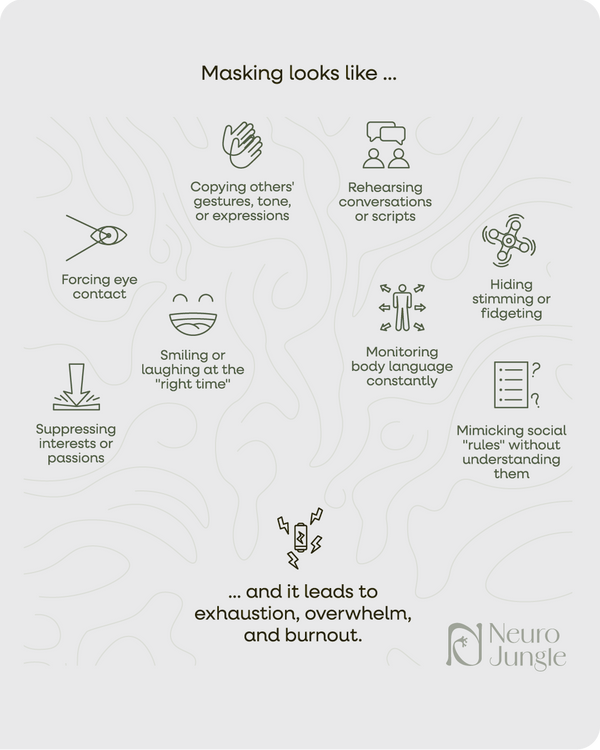
Masking is the act of consciously or unconsciously hiding or suppressing parts of your neurodivergent identity to fit into neurotypical expectations. It can include mimicking social behaviours, forcing eye contact, scripting conversations, over-preparing for tasks, suppressing autistic joy, minimising stimming/choosing ‘socially acceptable’ stims or pushing through sensory overwhelm without showing it.
Fluctuating Capacity
Fluctuating Capacity can be one of the most confusing and frustrating aspects of being neurodivergent, for both individuals and those around them. It is the inconsistency in what you are able to do from one day to the next.
Living With Fluctuating Capacity
Living with fluctuating capacity requires a compassionate, flexible approach. It means learning to:
-
Build routines that allow for downtime, not just productivity.
-
Design work and life structures that allow ebb and flow, not rigid consistency.
-
Communicate your capacity without guilt.
-
Develop a self-awareness of your own energy patterns and executive load.
-
Create systems of support that kick in before burnout sets in.
How can you help your team members?
-
Awareness and understanding goes a very long way to helping those who are struggling feel confident to express their needs without judgement. This, in turn, often has the benefit of enabling faster recovery.
-
Flexibility where possible in the workplace.
-
Leaders discussing openly how they build downtime for themselves can help others learn to do this.
-
Build in periods of rest and recovery for all team members after shoots with long hours, lots of travel etc.
Accessible
Communication
Neurodivergent individuals often process information differently. That includes how they give, receive and respond to communication. Making communication accessible is not just inclusive, it is essential for clarity, wellbeing and productivity.
Here are some simple adjustments that can make a big difference:
- Providing clear written instructions. Avoid ambiguity by breaking things down step by step.
- Sharing meeting agendas and information in advance. This helps people process and contribute meaningfully.
- Allowing for cameras off in online meetings. Reduces sensory load and allows for better focus.
- Recording and captioning meetings. This means information can be reviewed later and made accessible to all.
- Making sensory adjustments. Minimising noise, lighting and other sensory triggers where possible can create a more comfortable environment.
Sensory
Issues
Sensory issues refer to differences in how the brain receives, processes and responds to sensory input such as light, sound, texture, smell, movement and temperature. These differences are extremely common among neurodivergent people, especially those who are autistic, ADHD, dyspraxic or have sensory processing disorder (SPD).
Some people are hypersensitive (over-responsive) to sensory input - e.g. finding bright lights painful or loud noises unbearable. Others are hyposensitive (under-responsive) - e.g. not noticing they are injured or constantly seeking movement or pressure. Many experience both, depending on the sense and context.
The Eight
Senses
In addition to the five you may already know, there are three additional senses often affected in neurodivergent people:
|
|
|
Example of Sensory Difference |
| Sight (visual) | Light, colour, movement | Overwhelmed by bright film lights or fast-moving footage |
| Sound (auditory) | Volume, pitch, background noise | Hearing buzzing from lights or electricity others don’t notice |
| Touch (tactile) | Texture, pressure, temperature | Finding costume tags unbearable, disliking stage makeup |
| Taste (gustatory) | Flavour, texture, temperature | Gagging on food textures others find fine |
| Smell (olfactory) | Scents and chemical smells | Averse to perfumes, paints or cleaning products |
| Vestibular | Balance and movement | Difficulty with choreography, clumsiness, motion sickness |
| Proprioception | Awareness of body in space | Trouble judging personal space; knocking things over |
| Interoception | Internal sensations | Not realising they are hungry, thirsty or need the toilet |
What This Looks Like
On Set
Culmative
Overload
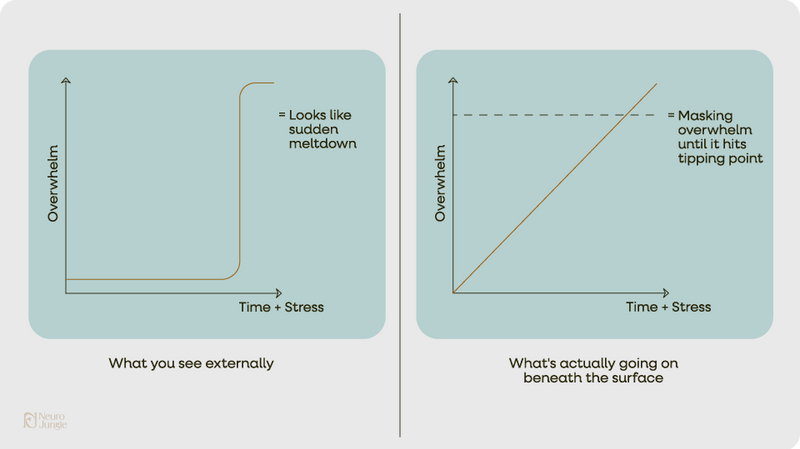
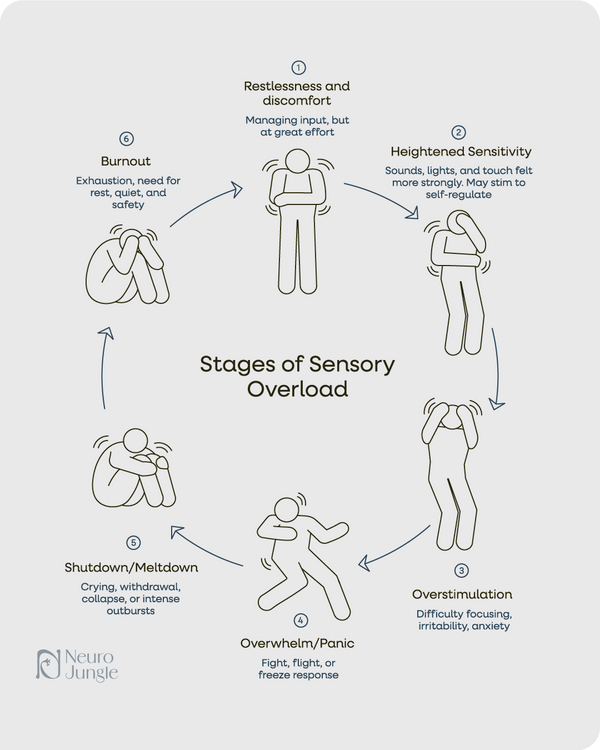
Sensory inputs build up and for neurodivergent people, this can lead to sensory overload: a state where the brain cannot process any more input. This may result in:
- Meltdowns (emotional outbursts)
- Physical withdrawal or freezing (shutdowns)
- Stimming (repetitive movements like hand flapping, rocking or jumping) to self-regulate
- The need to leave the space suddenly
Importantly, overload is often invisible until it is too late. Masking sensory discomfort takes a toll, and someone may appear calm until they are overwhelmed.
Designing Sensory-Aware
Workspaces
You can reduce barriers with simple changes:
|
|
Adjustment |
| Bright lights |
Offer lower lighting or shaded areas when not filming |
| Noise |
Permit noise-cancelling headphones; use soft-close doors |
| Smells |
|
Clothing discomfort |
Allow cast/crew to bring their own base layers or avoid certain fabrics |
Touch sensitivity |
Ask permission before touching during costume, makeup or sound fittings |
Sensory breaks |
Designate quiet rooms or vehicles for decompression |
Being watched |
Allow crew to step away from group settings to regulate in private |
Download this sensory audit template to assess your workplace environment.
Most Neurodivergence Workplace Consultants or trainers should also be able to help you conduct a sensory audit.
Neurodivergent
Strengths
Creative, outside-the-box thinking
Seeing connections others miss; generating original ideas and perspectives.
Deep focus (hyperfocus)
The ability to become completely absorbed in a task of interest and produce outstanding work.
Pattern recognition and systems thinking
Spotting inefficiencies, inconsistencies or innovative solutions within complex structures.
Strong sense of justice
A deep commitment to fairness, equity and doing what’s right.
Empathy and emotional intuition
A powerful ability to tune into others’ feelings, especially when supported to regulate one’s own.
Authenticity and honesty
A natural resistance to social pretence, leading to genuine relationships and clear communication.
Resilience and adaptability
After years of navigating systems not built for them, many neurodivergent people develop extraordinary flexibility and problem-solving skills.