
Every production has practices and policies in place to protect the welfare of its crew. But what are some of the specific considerations where it comes to director welfare, and how can producers support this key individual to do their best work on a production?
It's about trying to work out what gives them the space to be the best director.”
Setting
Expectations
It all begins with setting expectations. “It's making sure that they know what they're walking into.” Says Tim Sealey, Chief Operating Officer of Roughcut Television, producers of drama and comedy programmes, including Little Disasters and We Might Regret This. “We want to help them to know what they're walking into, we don't want to go, ‘oh yes, this is going be amazing’, and then it's like ‘we've actually really got four weeks to do it’. That's not fair.”

Trigger Point, produced by Hat Trick Productions
It’s the same for directors on Hat Trick Productions’ shows, says Jessica Sharkey, Director of Production at the Derry Girls and Trigger Point producer: “On our shows, they know what they're getting into. They know how many days they have to shoot the show in. They know what the budget is. They know what the constraints are. From interview stage, that has to be 100% made clear. And it's an executive's job not to then pull the rug from under them by suddenly massively changing the goalposts. Or if the goalposts are changed by the broadcaster or the funder, then you have to protect the director from that and take the flack for it.”
As well as setting clear expectations, Rachel Hooper at Walk on Air Films (WOA), makers of premium factual programmes, says a priority for their Belfast-based company is to make sure that the values of any director they hire are aligned to those of the company. They try to understand who the director is as a person and therefore how best the company can support them through production. That includes very clear conversations about values from the outset, and the option to have a ‘C-Me’ colour profile assessment. She describes this as “a kind of superpower in terms of understanding your team”. It allows her and co-founder Martha O’Kane to understand how a director’s personality may fit within the wider team and to anticipate what support they may need. “My job is to try and have a PhD in each director, you know, to kind of start to spot the signs. Where are the points at which they're going to need some additional support? What is it that they're anxious about?... it's about trying to work out what gives them the space to be the best director.”
Communication
& Consideration
Sometimes, logistical decisions necessitated by budget constraints can work in the favour of crew welfare. If you can’t afford to shoot on lots of different locations and move crew around, that can actually remove some of the stress on the director (and other crew members) associated with those elements of a shoot, says Sealey, who is largely making Band One and Two productions, shooting 10-hour days under the Pact Bectu Agreement. “We have to plan ourselves much more carefully. So that we don't go, ‘actually, we've got to move the unit every day’, because that's stressful. We can't afford to do that.” Directors, unlike other crew members, often have some say in how the shoot is scheduled, as well.
Some directors don't like executives sitting over their shoulder on set, but then some do.
Good communication throughout is essential, and establishing clear channels for it matters, whether that’s face-to-face or otherwise. A director should feel able to raise issues and ask for support when they need it. But producers also need to be sensitive to visual signs of stress or strain. Sharkey notes that there is a fine line for an executive to tread between being present so the director feels supported but not to the point of causing stress. “Some directors don't like executives sitting over their shoulder on set, but then some do, and some prefer it if the executives stay away and some don't. But we tend to try and be very present and (have an) open door policy.” She adds that executives should use their judgement to protect the director from outside noise and be a conduit for them: “It's about executives being good at their job, and about executives understanding production processes.”
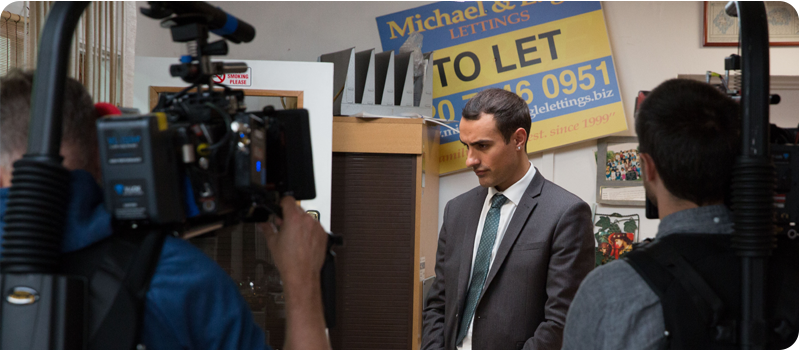
Stath Lets Flats, produced by Roughcut Television
When the subject matter of a production is challenging, a producer may look to provide additional resources to support the welfare of the director and wider crew. WOA, who co-produced the multi-award winning Once Upon a Time in Northern Ireland, works with a dedicated trauma therapist and the Wave Trauma Centre in Belfast on all of its productions. The therapist is there for the contributors as well as the crew, who can decide for themselves whether to access individual support or not. “Not everybody takes it up” says Hooper, “but I think that just knowing that that is there takes the pressure off them.” Bespoke training is also provided for the director and other crew members at the start of a production, “specific to the story that we're doing, that helps them to understand, ‘okay, what will this look like in terms of our contributors? What will this look like in terms of me? How do I think about all of that?’”
The nature of production sometimes means changes at short notice and the need to be flexible under pressure. For example, if a broadcaster comes with a late change to the script. “Everybody knows that late script changes are really, really difficult to deal with, and they don't give people enough time to prep, enough thinking time, they're stressful for everyone, they're stressful for the actors, for everybody” acknowledges Sharkey. But she adds that it’s never intentional. Changes may also come from the director once on set. It doesn’t necessarily mean a director hasn’t prepared sufficiently, it could just be part of their creative process. Sharkey adds: “That's part of making something good. Yes, we should reduce (last minute changes) as much as possible. We should make sure that everybody understands the consequences of it. We should make sure there's enough time for everybody. But at the end of the day, we're not making widgets to a pattern. We are dealing with creativity, and it doesn't always flow to schedule.”
Hooper sums up: “there will always be things that we haven't got right. But the more that you can work to make sure you have a loyal team, they will come back and work for you again. And that's the best thing.”
Best Practice
Takeaways
This content came out of discussions at the Directors and Producers Forum, which consists of representatives from Pact, Directors UK, BBC Studios and ITV Studios. The Forum was established to try to facilitate open and honest dialogue to improve working practices between directors and producers in UK film and television production.
A previous article, Best Practice When Hiring Directors on Productions was published in February 2026.
Pact would like to thank Jessica Sharkey, Rachel Hooper and Tim Sealey for their contributions to this article, and Directors UK and their members for their contributions.
Banner Image: Courtesy of Roughcut Television, from filming on Stath Lets Flats.