
Produced by Bristol-based Plimsoll Productions and commissioned by ITV Entertainment, Shark! Celebrity Infested Waters (2025) takes three world-renowned shark experts and a group of celebrities to The Bahamas, the shark capital of the world, to confront their fears and explore why shark conservation matters.
Timed to coincide with the 50th anniversary of Jaws, the series was an ambitious natural history hybrid commission featuring Ade Adepitan, Paralympic wheelchair basketball player, broadcaster, and environmental campaigner.
While Ade is an experienced adventurer and travel presenter who is used to navigating physically demanding environments, filming in open water and in close proximity to sharks introduced complex additional access considerations.
Executive Producer Andrea Jackson and Commissioning Editor of ITV Entertainment & Reality, Kevin O’Brien reflect on their key take aways from the production. How access was considered from the outset and the key ADJUSTMENTS they put in place to support the physical and emotional wellbeing of their on-screen talent.
We thought about access before greenlight
Kevin O’Brien - Commissioning Editor, ITV Entertainment & Reality at ITV
Plimsoll first brought Shark! to us with no cast attached, but it was a really good sizzle, so we commissioned it into development subject to talent.
When Ade Adepitan’s name was suggested by production, we were all so excited at ITV. I knew Ade had the right enthusiasm for this project. He was climate aware and a passionate environmentalist.
He had the most dive experience of all the celebrities. But we knew that his on-screen experience would be very different from theirs, and that the hurdles he would have to overcome were going to be greater. So that was the point we started conversations with the production. If we were going to book Ade, what did we need to do to ensure this booking would go smoothly?
Andrea Jackson - Executive Producer
Once the Channel confirmed Ade’s booking, it became really important to us, and really important to him, that throughout this process we were taking his advice. It should never be us saying ‘it needs to be done this way’. We needed to be led by Ade.
A lot of access considerations need to start at the pre-planning stage, so collectively, as much as we can, we can see ahead to what difficulties might be presented. As a production, we needed to make sure he felt we had his back and minimised friction wherever we could.
One of the challenges we discussed before we went out was getting on and off boats, which is obviously much harder if you’re a wheelchair user. We were limited by the boats available in the Bahamas, so we went to ITV to see if we could access additional funding to hire another boat with easier access. It made a world of difference to staying on schedule. If anything holds us up, that’s on us as a production.
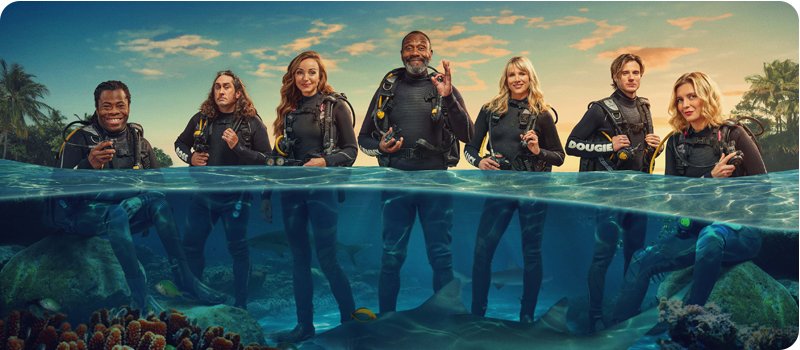
We are going to need a bigger boat!
Kevin O’Brien:
Plimsoll came to me and said, ‘this is going to sound silly, especially given the nature of the show being so Jaws-inspired, but in order to make this work, we’re going to need a bigger boat.’ So, I took that access funding request to Sam Tatlow (Head of Diversity, Equity and Inclusion at ITV).
What a lot of indies don’t realise is that those pots of money exist (via an access funding request) and they’re accessible. It’s not something you have to jump through loads of hoops to get. When the access need is properly demonstrated, commissioners and the DE&I team are only too happy to try and secure funding.
Andrea Jackson:
It’s a relatively simple online application. You have to explain why, put together a budget, and describe exactly how the money will be used. We were able to make all of this happen without any significant delay. It was a game changer for us.
Everybody could communicate with much more confidence
Andrea Jackson:
It became very apparent that there were a number of people that just didn’t feel comfortable with the language they were using. That was hampering communication because people were so scared or hesitant to say something because they didn’t want to cause offence. So, we went to ITV and we spoke with Sam Tatlow, who gave us some really good advice and some printed documentation we could share with the production crew.
Once we shared that guidance, suddenly everything changed. Everyone felt much more able to speak fluently, as you would with any member of our on-screen talent.
There are no one-size-fits all solutions on location
Andrea Jackson:
We tested flotation devices, underwater scooters, different fins, and did extra training (also paid for via an Access Funding Request). We didn’t want to rely on one thing working.
Even with all the planning and testing, things didn’t always work as we hoped. We’d practised, but when we were out in the ocean something went wrong with the underwater scooter and it stopped working. That’s why having backup plans and safety support was essential, and communication and trust were integral.
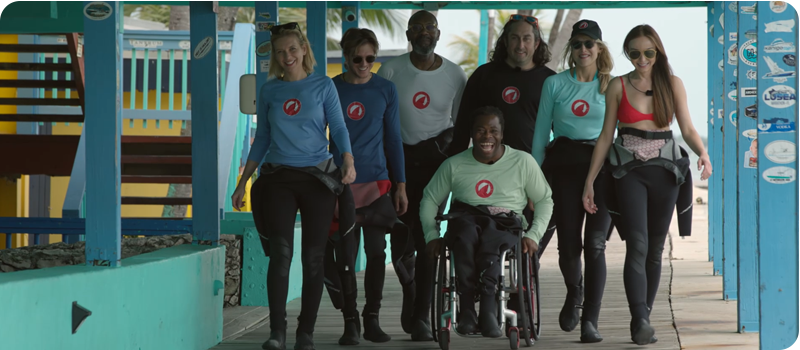
The cast of Shark! Celebrity Infested Waters
There's a real creative advantage in empowering Disabled talent
Kevin O’Brien:
Ade said from day one, if you’re going to book me, we’re not covering bits up. I want to show exactly what I have to deal with every day. It would have been very easy to edit around things like the boat transfer, but he wanted that on screen. He said, ‘this is my life.'
We didn’t want you to see him on a boat and then suddenly underwater. We wanted to see the process. For a young Disabled audience member watching, that’s empowering. It shows what’s possible, and it doesn’t sanitise lived experience.
There’s sometimes a fear that having complex access requirements will make a show harder or less dramatic. In this case, it did the opposite. It made better television. And it showed that with planning, funding and openness, there really isn’t a reason not to do this.
Andrea Jackson:
The adaptations that we made, made a huge difference to Ade’s experience. That’s certainly what he said to us. A lot of time had gone into thinking about, for every scene that we shot, how was he going to get there, how was he going to get out of there, and what else he might need to make the experience more comfortable.
It all added depth to the storytelling. It added jeopardy. And it meant Ade was never excluded from an experience.